
Drug Checking
More information to come!
Register here: https://drugpolicy-org.zoom.us/webinar/register/WN_WE-SgNQHTPapKckViZndzQ
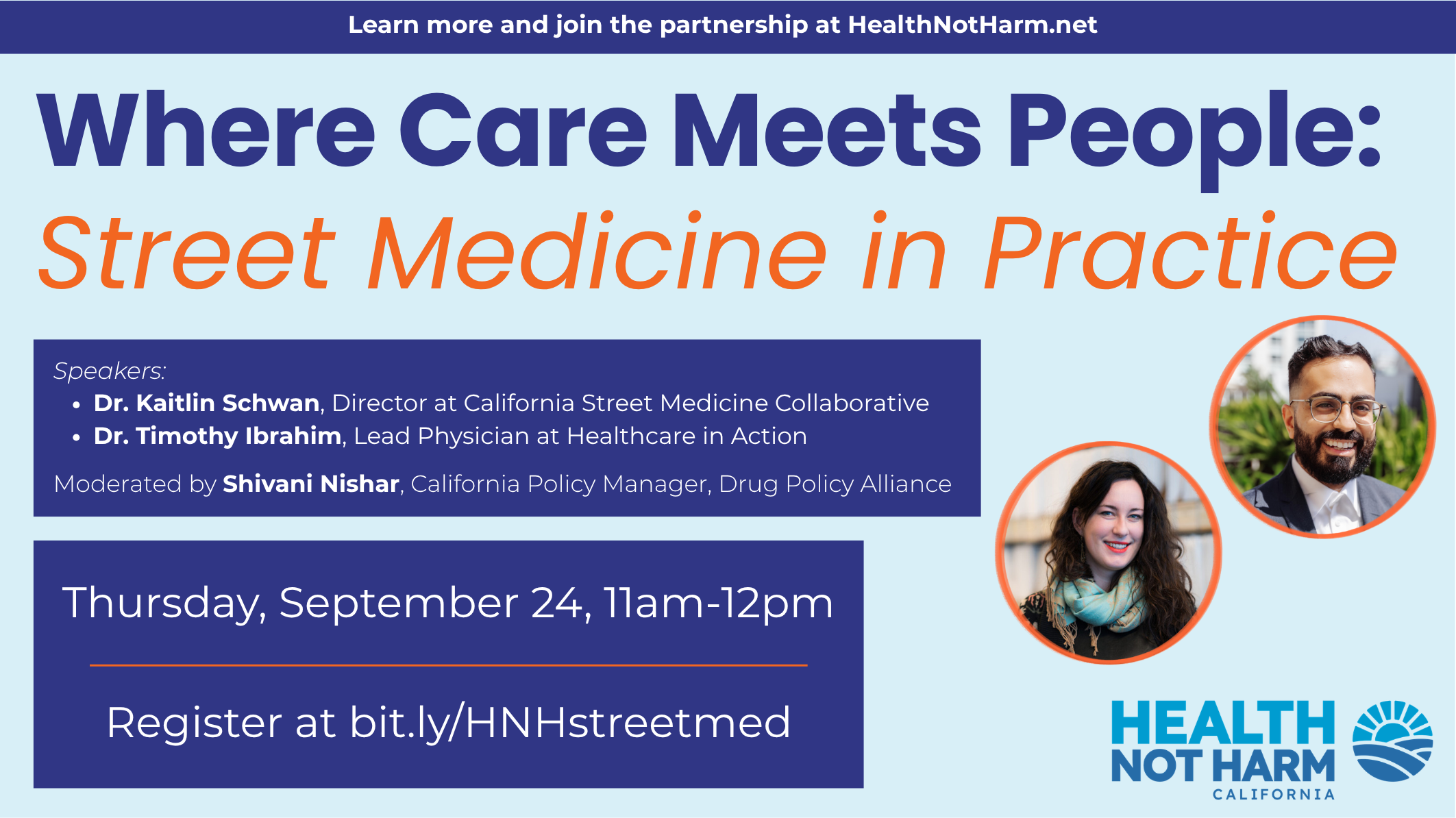
Where Care Meets People: Street Medicine in Practice
For people experiencing unsheltered homelessness, getting healthcare often means overcoming barriers that traditional healthcare systems are not designed to address. Street medicine flips that model—bringing care directly to people where they are, whether that’s an encampment, sidewalk, park, or underpass. By pairing clinical care with relationship-building, behavioral health and substance use treatment, wound care, and connections to housing and other resources, street medicine offers a pathway into a healthcare system that many patients have struggled to access or trust. In this webinar, experienced street medicine leaders will share what they’ve learned from practicing medicine outside the clinic, and what policy and system-level changes are needed to expand access and make street medicine sustainable at scale.
Watch the recording here: Where Care Meets People: Street Medicine in Practice
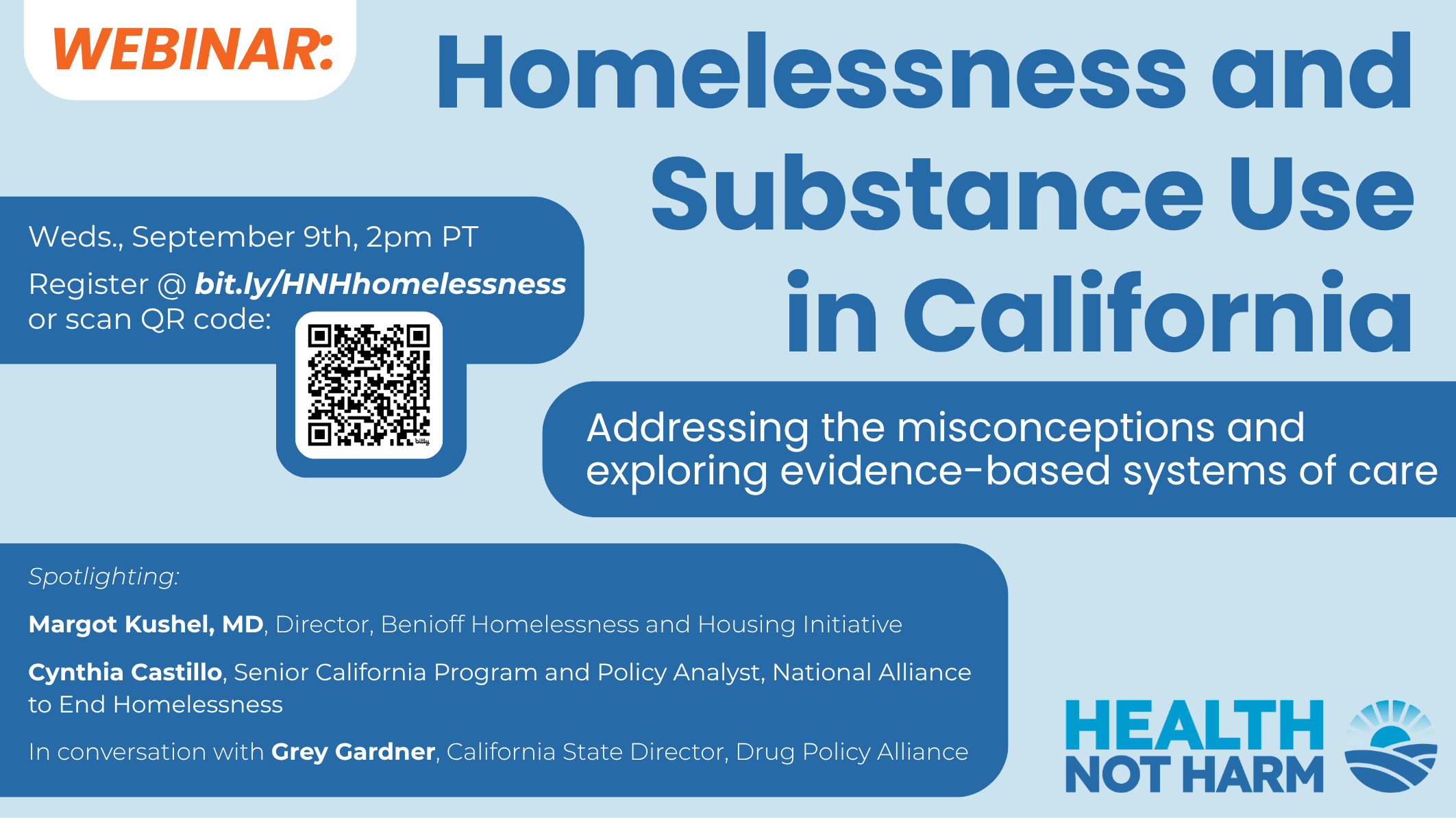
Homelessness and Substance Use in California: Addressing the misconceptions and exploring evidence-based systems of care
The intense rhetoric about homelessness continues to dominate California’s debates on behavioral health, drug use, and public safety. Yet many of the narratives about people who are unhoused revolve around unfounded assumptions, misleading claims, and faulty research about substance use, which are often used to bolster efforts to expand criminalization of homelessness. In this Health Not Harm webinar we spotlight Margot Kushel, director of the Benioff Homelessness and Housing Initiative, and Cynthia Castillo, Senior California Program and Policy Analyst at the National Alliance to End Homelessness, to provide an evidence-based assessment of the complex relationship between homelessness and behavioral health and how health-centered approaches can ensure that all Californians have access to low-barrier, high-quality care. Join us as we unpack the data behind California’s homelessness crisis and investigate the most effective ways to address it.
Watch the recording here: https://www.youtube.com/watch?v=ncjS1x8cP3I
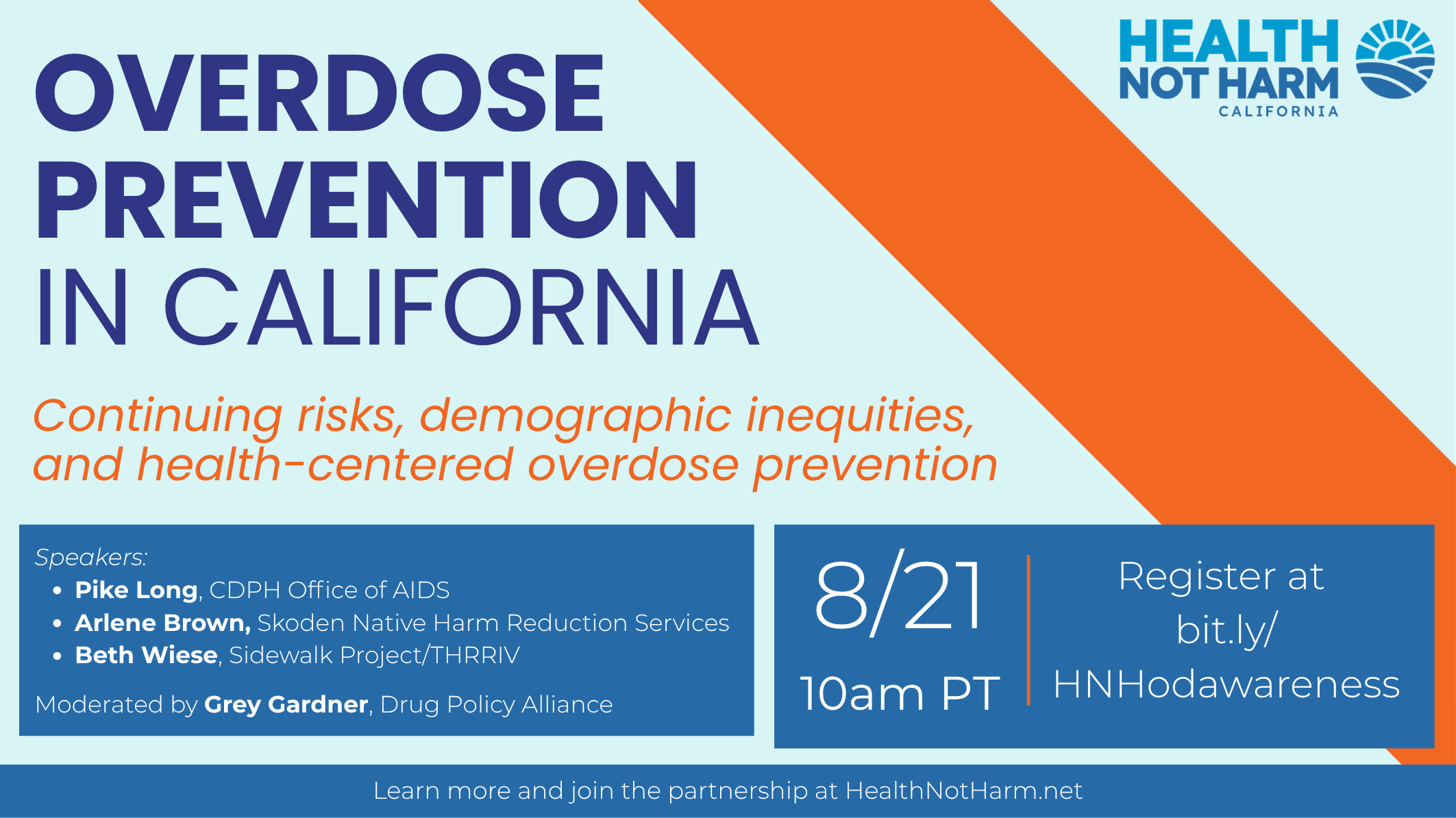
Overdose Prevention in California: Continuing risks, demographic inequities and health-centered overdose prevention
After years of increases, fatal overdose rates in California have started to decline, thanks in large part to the tireless efforts of our partners to expand access to lifesaving tools and services—including naloxone, low-barrier treatment, safer-use supplies, and overdose prevention education. But there is still an urgent need to act. In each of the past two years nearly 10,000 Californians died from a drug overdose. It's critical that we continue advancing solutions that prevent overdose and also promote long-term health and well-being. As we commemorate International Overdose Awareness Day, we are spotlighting the data, the research, and the work of community-based partners who serve people at greatest risk of fatal overdose. Together, they explore the importance of addressing longstanding inequities in access to care that contribute to disproportionately high rates of overdose among Black, Brown, and Indigenous communities; research findings that point to new and better ways to prevent overdose; and emerging risks that demand action.
Watch the recording here: https://www.youtube.com/watch?v=MU320QV8tVQ
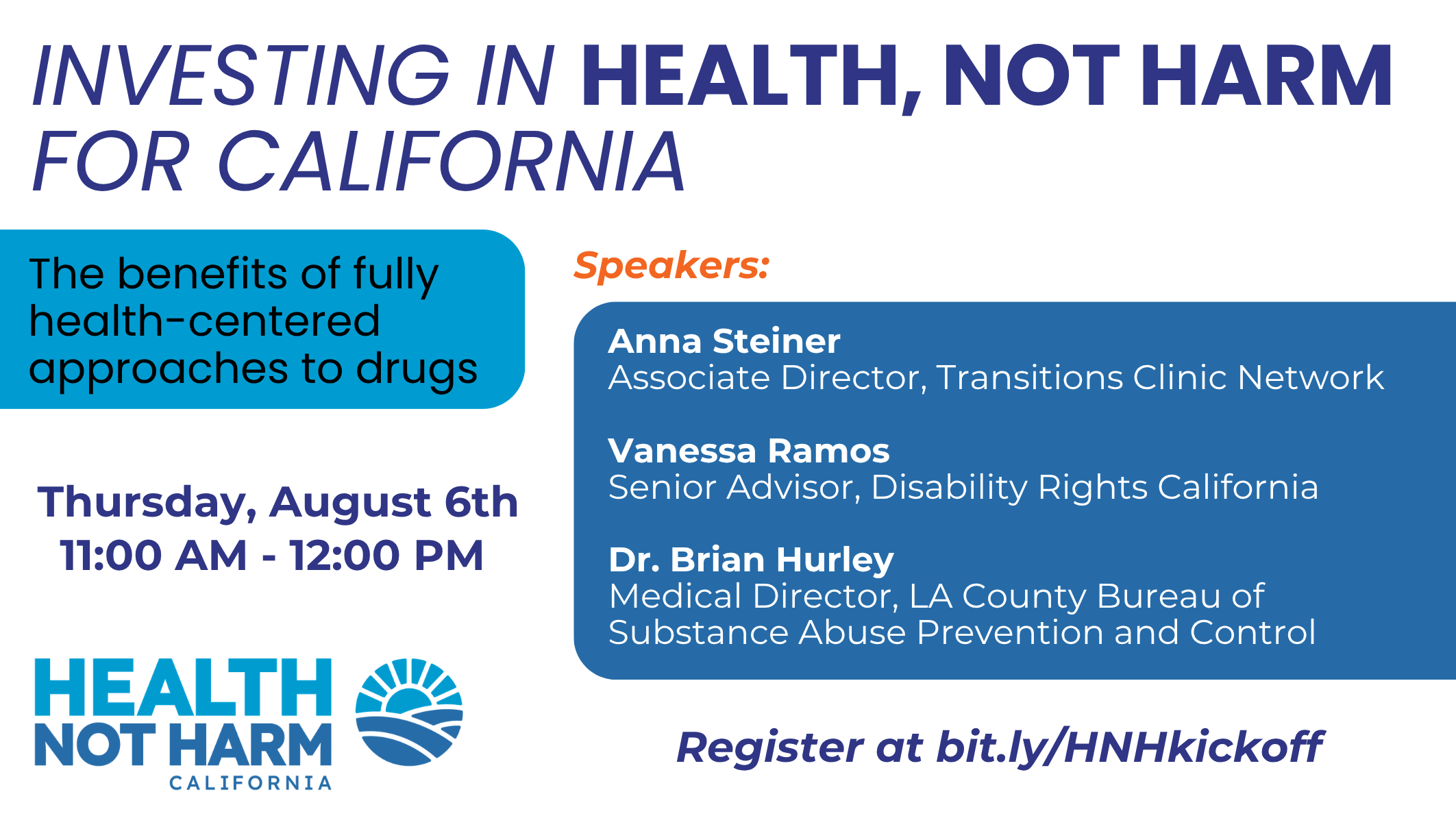
Investing in Health Not Harm For California: Webinar Series Launch
California has led the nation in many health-centered innovations in addressing substance use, while also seeing the proliferation of laws and services that rely on criminalization and coercion of people experiencing substance use disorder. Hear from experts in substance use disorder treatment and addiction care about the benefits of health-centered approaches to drugs that save lives and provide better pathways to voluntary care for those who need it. We'll discuss what these approaches look like in practice, why they work, and what it will take to make health—not harm—the foundation of California's response to substance use.
Watch the recording here: https://www.youtube.com/watch?v=OyLvOl4PlJM
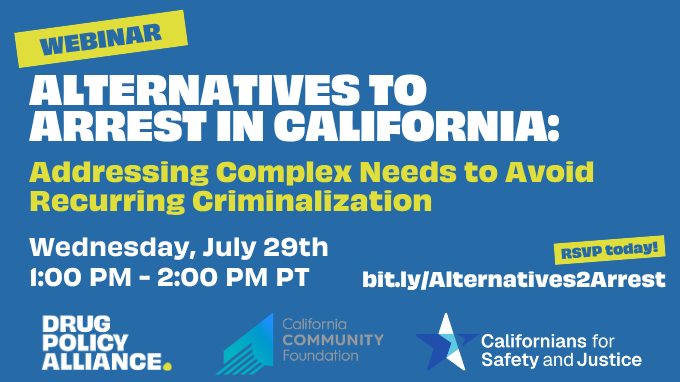
Alternatives to Arrest in California: Addressing Complex Needs to Avoid Recurring Criminalization
The LEAD program in Los Angeles provides pre-arrest intensive case management to meet complex needs, often relating to behavioral health, and prevent recurring arrests. The Los Angeles program, following the "Law Enforcement Assisted Diversion" (LEAD) model utilized in many communities throughout the U.S., has proven successful in reducing arrests and facilitating connections to care.
Panelists will discuss the ongoing work in Los Angeles, the Alternatives to Arrest model, recent legislative efforts to expand eligibility and funding for such projects, and pathways toward building similar programs throughout California. Hosted by the Drug Policy Alliance (DPA), Californians for Safety and Justice and the California Community Foundation.
Watch the recording here: https://www.youtube.com/watch?v=4k3hnEc-vvY

CA Bridge Connect Virtual Kick-off Event
CA Bridge Connect is now live across California, and we want you to be part of what comes next. Whether you work in substance use care or for a community-based organization, whether you’re a peer supporter or simply care about making sure your neighbors can access addiction treatment when they need it, this event is for you.
What to expect: You'll hear directly from the people making CA Bridge Connect possible, including a navigator who answers the helpline daily and a community-based clinician supporting connections to care.
We'll walk through how CA Bridge Connect works – using the helpline as a participant, loved one, or referring clinician – and ways to widen its reach in your community. We'll leave significant time for questions and conversation about how to continue to ensure CA Bridge Connect can sustainably serve our California communities.
Who should join: Anyone in the state of California, namely, healthcare professionals, navigators, community-based organizations, social service sites, people seeking addiction support or their loved ones, and community leaders.
Hosts:
Arianna Campbell, DMSc, MPH, PA-C
Cheryl Anne Batac, MPH, CHES
Panelists:
Katie Quijada, MPH, CHES, CHW
Reb Close, MD
Registration: https://forms.zohopublic.com/aria4/form/CABridgeConnectVirtualKickoff/formperma/tS6Lx7cKjY5SfhV67ApZXK4ah2cV8reS_kYW6vCFwjA
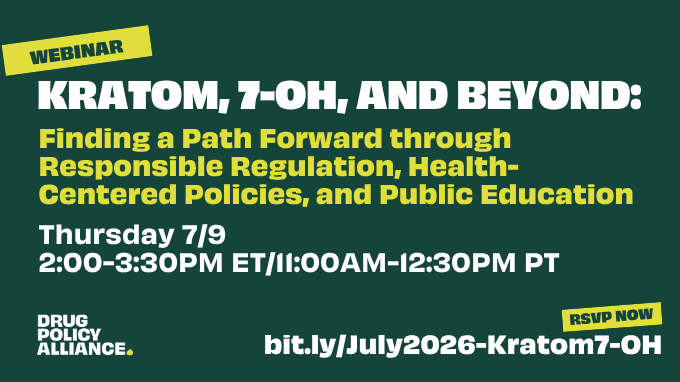
Kratom, 7-OH, and Beyond: Responsible Regulation and Health-Centered Policies
In the past few years, over half of U.S. states have introduced legislation to regulate or criminalize kratom and/or kratom-derived products, including 7-OH. At the federal level, the Food and Drug Administration (FDA) recommended scheduling 7-OH under the Controlled Substances Act; meanwhile, President Trump has signaled interest in sanctioning kratom for medicinal use. Across the country, people who use kratom, advocates, healthcare providers, and policymakers remain divided on how to best provide education and support to reduce the potential harms of products sold as kratom and 7-OH. What’s the way forward?
In this webinar, the Drug Policy Alliance will convene leading experts to discuss the current status and the future of kratom and 7-OH: What are kratom and 7-OH? Who uses these substances and what health benefits and risks do people experience? What is the legal status of kratom products and what can we expect moving forward? For kratom and 7-OH — as well as for other “gas station,” drugs, emerging drugs, and substances of uncertain legal status — what policies do we need to keep people safe? What are the impacts of regulating, scheduling, or banning kratom, 7-OH, and other emerging drugs? How might prioritizing regulation over criminalization lead to greater oversight of manufacturing and sales, more consumer safety and education, and reduced health risks? Recording date: July 9, 2026
Moderators:
Kellen Russoniello, JD, MPH, Director of Public Health at Drug Policy Alliance
Maritza Perez Medina, JD, Director of the Office of Federal Affairs at Drug Policy Alliance
Speakers:
Shoshana V. Aronowitz, PhD, MSHP, FNP-BC, University of Pennsylvania School of Nursing
Katherine Hill, MPH, Yale School of Public Health
Stacey McKenna, PhD, R Street Institute
Cat Packer, JD, MA, Director of Drug Markets & Legal Regulation at Drug Policy Alliance
Darshan Singh, PhD, MPA, Centre for Drug Research at Universiti Sains Malaysia
Recording Available: https://www.youtube.com/watch?v=HzNob7rKKOk